Lunds domkyrka
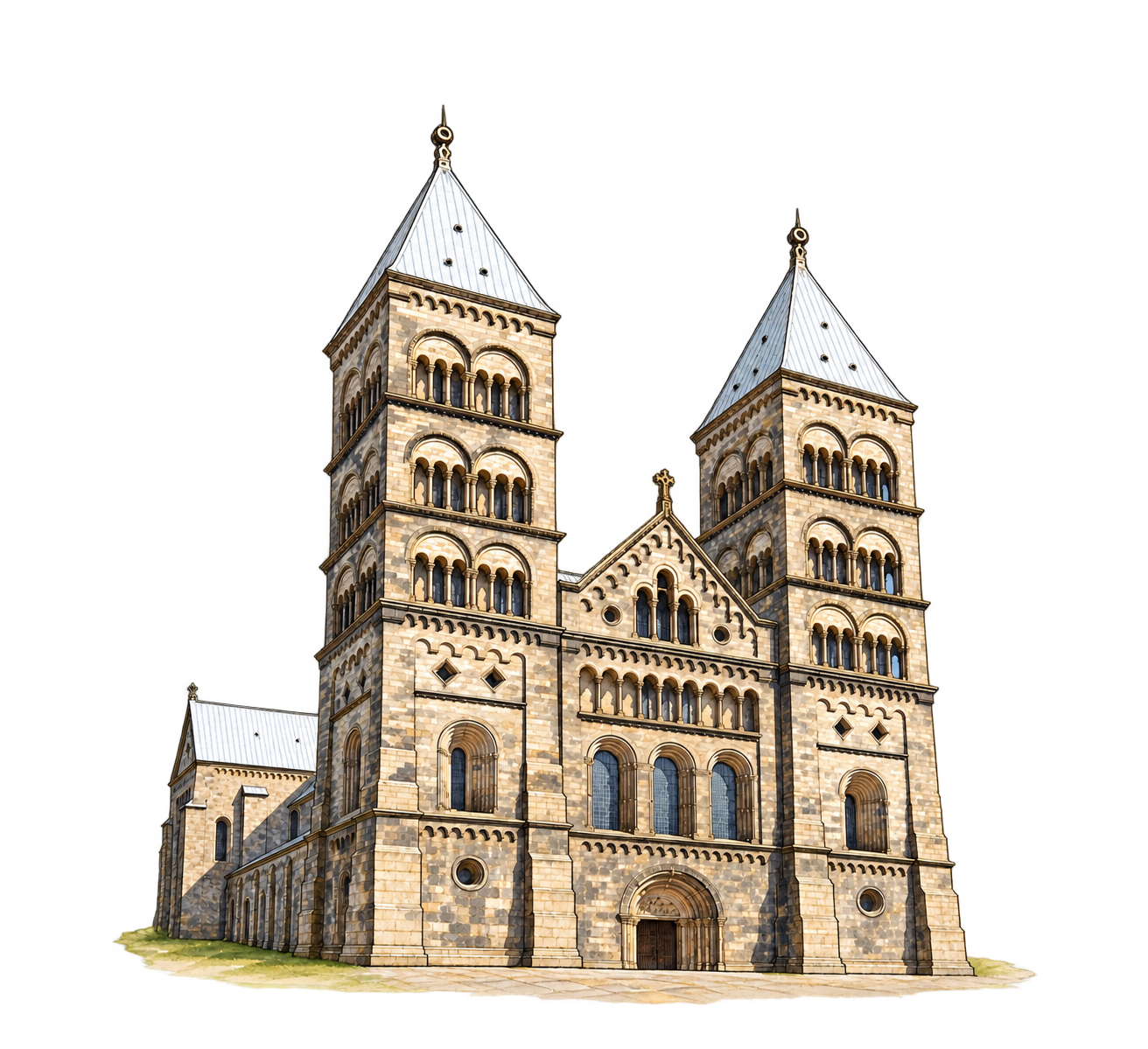
Lunds domkyrka rises above the centre of Lund with two sandstone towers and rows of rounded arches. Begun in the late eleventh century, this Romanesque cathedral holds a medieval crypt and an astronomical clock, with later restorations shaping the building seen today.

Nine centuries in stone
From the crypt’s first altar to the towers and mosaic that visitors recognise today.
The crypt altar is consecrated
On 30 June, worship begins at the crypt altar, twenty-two years before the cathedral’s consecration.
A cathedral is consecrated
Archbishop Eskil consecrates the cathedral and its high altar on 1 September.
Rebuilding after fire
Fire destroys the wooden roof. Brick vaults become part of the cathedral’s reconstruction.
Time, stars and a calendar
The astronomical clock brings together the movements of the heavens and the rhythm of the church year.
The university opens here
Lund University is inaugurated in the cathedral, which also provides rooms for its early teaching.
The familiar towers take shape
Helgo Zettervall’s replacement towers are completed during a major restoration of the cathedral.
The clock returns
After reconstruction, the astronomical clock is brought back into use.
A mosaic above the choir
Joakim Skovgaard’s mosaic in the apse is completed, adding a new chapter to the cathedral’s interior.
Three things to notice
A few details to pause over, outside the cathedral and within its walls.
The paired towers
Look up at the tiers of rounded arches and the pointed roofs. The two 55-metre towers frame the west front and its sandstone entrance.
The astronomical clock
Look for the sun and moon on the upper dial and the calendar below. When the clock plays, carved figures pass Mary and the infant Jesus.
The crypt and Finn
In the crypt, notice the varied column carvings and the figures holding the stone pillars. Local legend connects them with the giant Finn and his family.
The full church story
Lunds domkyrka grew from a building campaign begun in the late eleventh century. A substantial gift from the Danish king Knut IV in 1085 helped secure its foundations. Archbishop Eskil consecrated the cathedral in 1145, dedicating its high altar to St Lawrence and the Virgin Mary.
Below the choir, the crypt takes the story back further: its altar was consecrated on 30 June 1123. Carved marks in the masonry preserve traces of the people who shaped the stone. The space has needed considerable care over the centuries, including drainage work and the strengthening of its foundations. Figures clasping the columns inspired the legend of the giant Finn, a story attached to the building rather than a historical account of its construction.
Fire in 1234 destroyed the wooden roof; rebuilding brought brick vaults. Later generations added objects that still reward a closer look. The astronomical clock dates from around 1425. Its upper dial follows the sun, moon and stars, while the lower section is a calendar. Dismantled in 1837, it was reconstructed by Theodor Wåhlin and Julius Bertram-Larsen and returned to use in 1923.
The cathedral also belongs to the history of learning in Lund. The university was founded in 1666 and inaugurated here on 28 January 1668. In its early years, before it had premises of its own, much of the university’s teaching took place inside the cathedral.
The skyline tells a more recent chapter. Nineteenth-century restoration transformed the west front, and Helgo Zettervall’s new towers were completed in 1880. Their Romanesque appearance belongs to that later rebuilding, an important distinction when looking at a church whose history reaches back to the Middle Ages.
Inside, different periods remain side by side. The oak choir stalls date from the fourteenth century, and the high altar’s carved altarpiece was donated in 1398. Above them, Joakim Skovgaard’s large mosaic, completed in 1927, depicts Christ at the Last Judgement. Glass and stone bring a twentieth-century layer of colour to the older architecture.
Plan a visit
Kyrkogatan 6, 222 22, Lund
Opening hours
Provider-listed schedule, applicable on 27 Nov 2026. All times are local to Sweden.
| Monday | 08:00–18:00 |
|---|---|
| Tuesday | 08:00–18:00 |
| Wednesday | 08:00–18:00 |
| Thursday | 08:00–18:00 |
| Friday | 08:00–18:00 |
| Saturday | 09:30–17:00 |
| Sunday | 09:30–18:00 |
Check access with the parish before travelling. Services and seasonal changes can affect visits.
What’s on at Lunds domkyrka
Loading calendar… Events will appear here automatically when the first background fetch finishes.
Contact & official information
Lunds domkyrkoförsamling
- Telephone +46 46 358700
- Email info@lundsdomkyrka.se
Check the official pages below for opening hours and visiting information. We may not have the latest details, and access can change for holidays, services or private ceremonies. If the information is unclear, contact the parish before travelling.
Facilities & accessibility
- Toilet
- Café
- Hearing loop
- Ramp
Listed by the provider; availability has not been independently checked. An unlisted facility is not necessarily unavailable.
A listed ramp does not confirm step-free access throughout the building.
Find your way
Use the interactive map to explore the church and the surrounding landscape.
The interactive map could not load. Use the location link below.