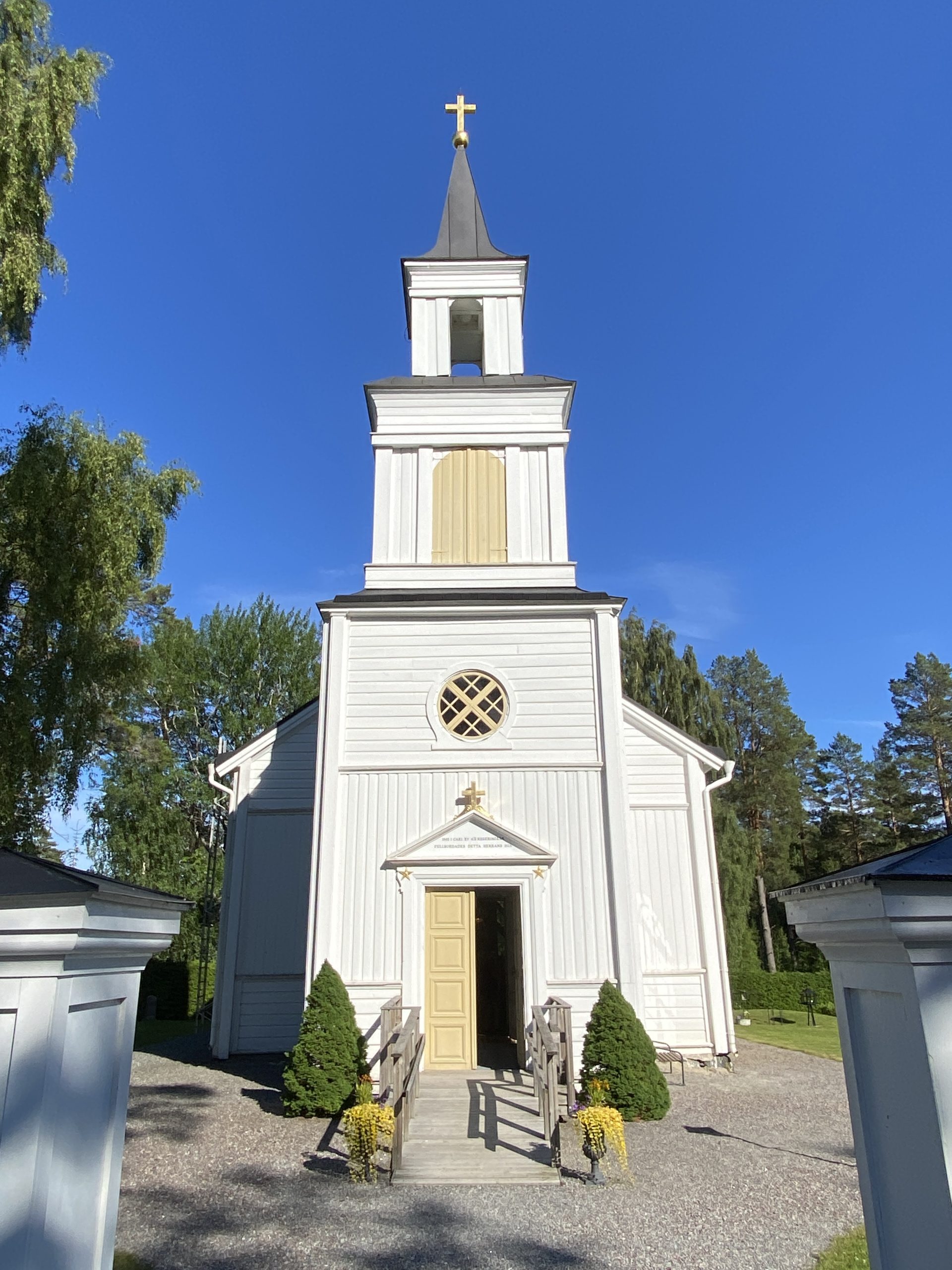
Construction was led by master builder J. Wassberg to his own design, with official approval and plans from the Överintendentsämbetet following in 1857 — by which point work had already progressed too far to change without cost. The church was pressed into use in 1857 despite being unfinished and unconsecrated, and stood complete with its tower by 1865.
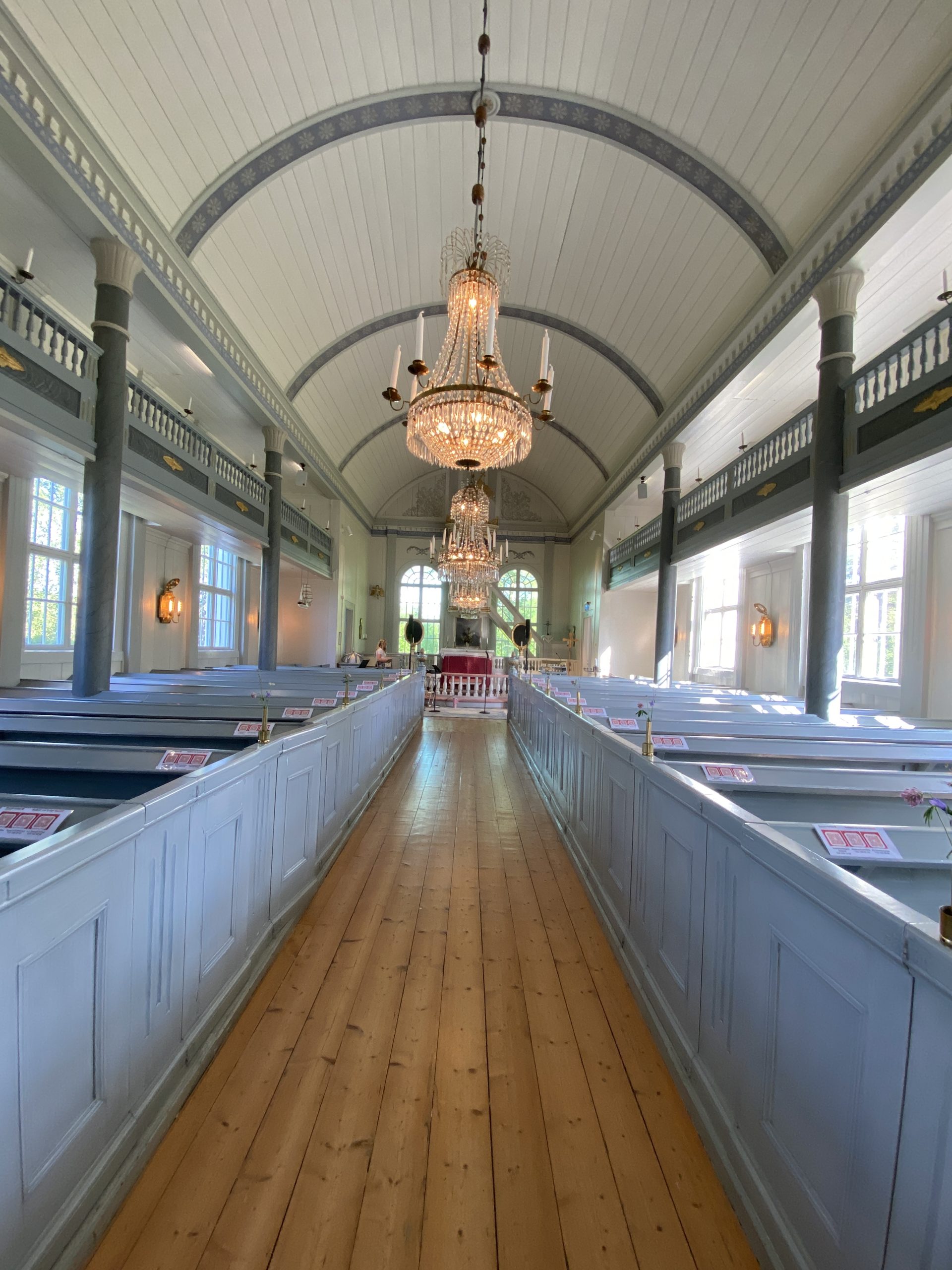
Consecration was delayed for decades. According to Wikipedia, the parish requested consecration in June 1926 against the wishes of the then bishop, who objected to the altar pulpit's design — the same feature that had caused disagreement during construction. The building is neoclassical in style, built entirely of timber, with a nave and straight-ended chancel to the east, a west tower, and small transepts flanking the chancel. Inside, the space is divided into three aisles, with galleries in the side aisles carried on columns with lotus capitals, and a wooden barrel vault over the central aisle.
The altar pulpit, painted white and gold, was made in 1864 by Lars Erik Hofrén; its unconventional design was apparently the point of contention with the bishop. The font and numeral boards are contemporary with the church. A gilded wooden votive fish hangs near the entrance to the church interior, a distinctive and unusual decorative touch for a parish church of this size.
The organ, with six stops and pedal, was built by Johannes Menzel Orgelbyggeri and installed in 1981. The small bell in the porch has had an interesting earlier life, having previously served as a harbour bell in Prästhus village on Hemsön and later as a school bell at Gådeåskolan in Härnösand.
The church's exterior walls were rendered (reveterade) in 1987–1988.