Dals kyrka
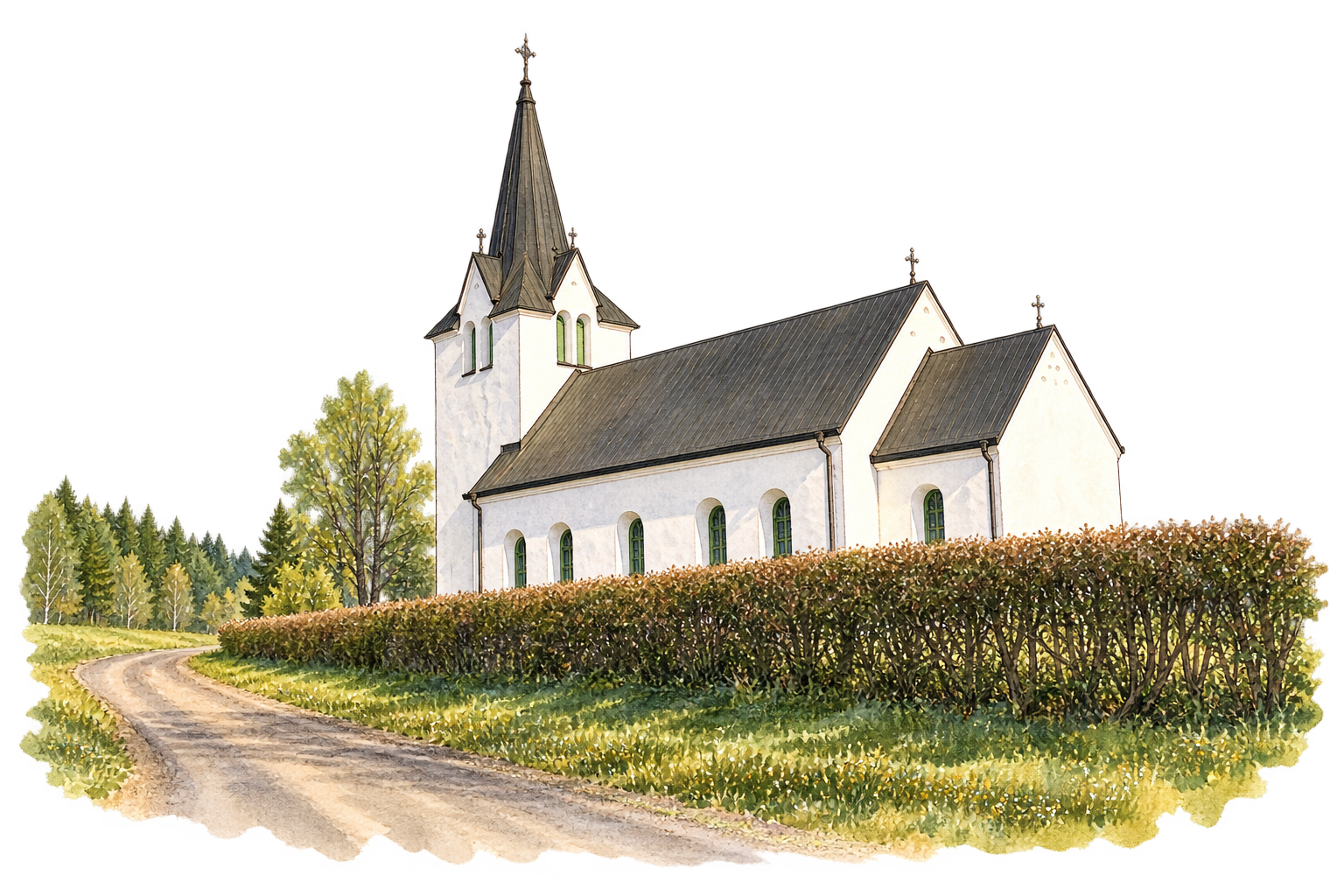
Dals kyrka rises above a hedge in Kyrkdal, its slender spire standing over a much older church. Inside, the story includes a remarkable homecoming: furnishings sold in the nineteenth century were saved and eventually returned.

A church, changed and rediscovered
Medieval masonry, a later spire and furnishings that found their way home.
Medieval beginnings
Probably built in this century; the exact date remains uncertain.
A carved pulpit
Magnus Gran creates the richly ornamented Baroque pulpit.
A longer church
The building is extended with another star vault.
A new silhouette
The tower replaces the old detached bell tower.
The furnishings return
Restoration brings the saved historic interior back to the church.
Three things to notice
The exterior tells its story through shape and proportion.
The slender spire
A narrow dark spire rises from the white tower, with small triangular gables around its base.
The stepped roofline
The long nave and lower eastern extension form two distinct roof heights, each with a small ridge finial.
Green-framed windows
Rounded windows punctuate the white walls, with a pair of narrow openings high in the tower.
The full church story
In the reference photograph, the church appears above the lane and a clipped hedge. White walls, dark roofs and green window frames form a quiet sequence from the tall western tower to the lower eastern extension. The hedge hides the base of the building; the illustration keeps that view rather than inventing the details behind it.
The parish places the church’s beginnings probably in the fourteenth century. Its exact age remains uncertain because early records were lost in a fire at Torsåker, once the mother parish. The oldest part was dedicated to Saint Agnes and survives beneath the two eastern star vaults.
Another vault was added when the church was extended in the early nineteenth century. In 1889–1890, the present tower replaced a detached bell tower, changing the building’s silhouette. The pointed spire seen today therefore belongs to a later chapter than the medieval masonry beneath it.
The same nineteenth-century renovation removed older furnishings. Erik Eriksson of Ålsta secured the pulpit and gallery front and placed them with the county museum in Härnösand, on the condition that the parish could reclaim them. That foresight mattered in 1936–1937, when the historic furnishings returned during restoration.
The parish identifies the richly carved Baroque pulpit as Magnus Gran’s work from 1737. The gallery front carries Christ as Saviour of the World with the twelve apostles. These pieces make the interior a story of preservation as well as change. The old altar did not survive; its replacement was kept simple to sit alongside the recovered furnishings.
A limestone baptismal font offers an older connection. The parish believes it may date from the church’s medieval beginnings and identifies its stone as Gotland limestone. That dating is presented as a possibility, not an exact surviving construction record.
Plan a visit
DAGLÖS 112, 873 92, Bollstabruk
Opening hours
Opening hours have not been confirmed for the current date. This does not mean the church is closed.
Check access with the parish before travelling. Services and seasonal changes can affect visits.
What’s on at Dals kyrka
Loading calendar… Events will appear here automatically when the first background fetch finishes.
Contact & official information
Dals församling
- Telephone +46 612 85500
- Email kramfors.pastorat@svenskakyrkan.se
Check the official pages below for opening hours and visiting information. We may not have the latest details, and access can change for holidays, services or private ceremonies. If the information is unclear, contact the parish before travelling.
Facilities & accessibility
- Toilet
Listed by the provider; availability has not been independently checked. An unlisted facility is not necessarily unavailable.
Find your way
Use the interactive map to explore the church and the surrounding landscape.
The interactive map could not load. Use the location link below.