Domkyrkan
Domkyrkan in Karlstad stands on Lagberget, its white walls and slender spire rising above the town centre. The setting belongs to a story of fire and rebuilding: an eighteenth-century church on higher ground, with an interior shaped by both classical design and later restoration.
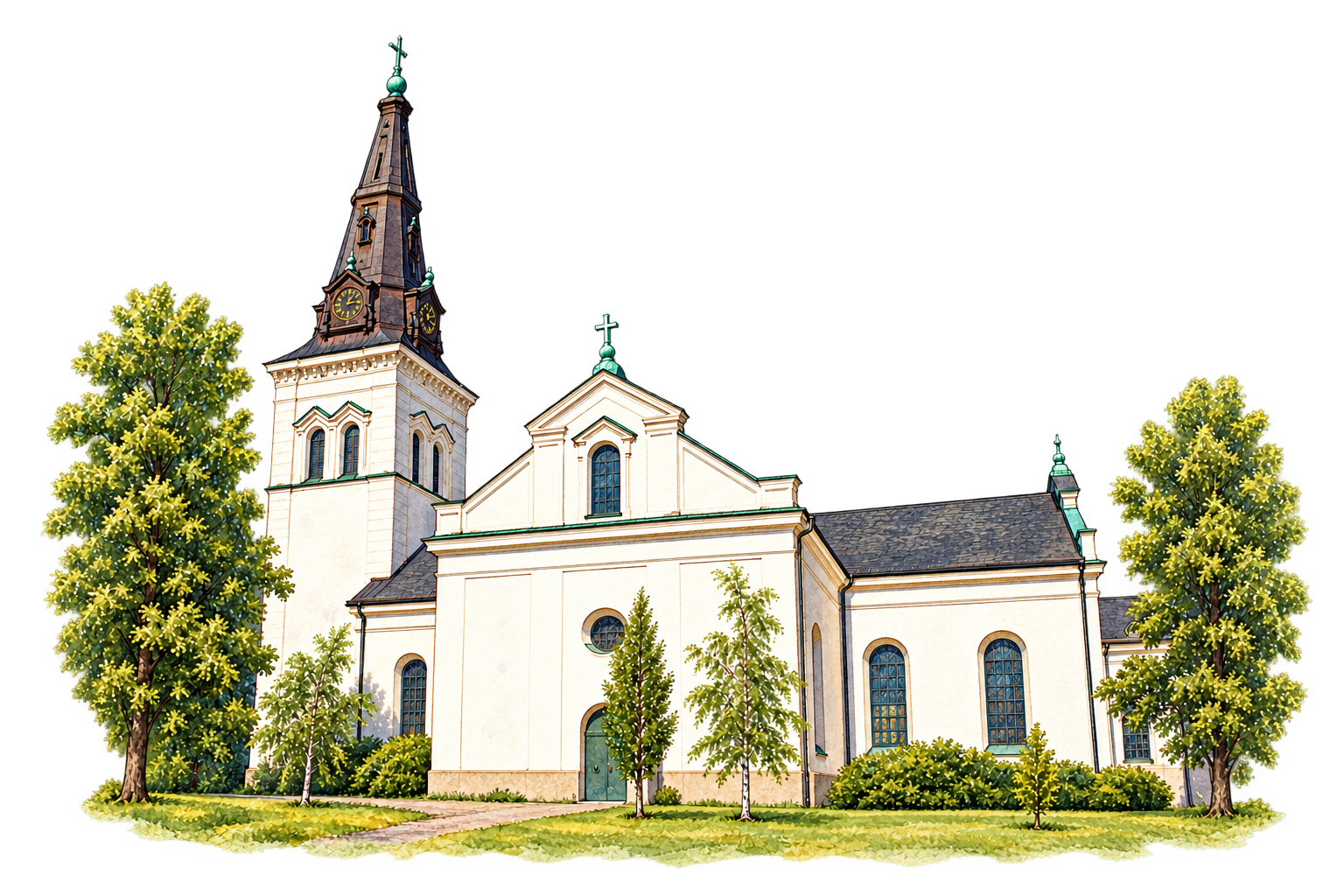

A cathedral on higher ground
Fire, a new setting and the gradual making of today’s church.
Karlstad becomes a cathedral city
The earlier town church gains a new role.
The old church burns
Rebuilding moves to higher ground.
The new church is consecrated
The congregation gathers on Lagberget.
The western tower is completed
A landmark rises over the town.
Fire strikes again
Roof, tower covering and bells are lost.
The choir is reshaped
A freestanding altar becomes part of the restored interior.
Three things to notice
Look a little closer at the building and its changing story.
The cross-shaped building
Follow the projecting arms and gables around the church.
The slender spire
Clock faces and a steep dark spire stand above the pale tower.
The classical choir
Look for Palmstedt’s architectural setting and the sculpture casts after Sergel.
The full church story
Karlstad became a cathedral city in 1647. Its earlier church stood close to Klarälven, where flooding was a recurring problem. When that building burned in 1719, the decision to rebuild offered a chance to choose a different site. Lagberget provided the higher ground that still defines the cathedral’s setting.
The present church was built in 1723–1730, with Jonas Fristedt and then Christian Haller involved in the work. Its original Greek-cross plan gave the building four projecting arms. The western tower followed in the 1730s. From outside, the meeting of the arms and their gables still helps explain how the building is arranged.
Not everything from the old church was lost. The parish records two chandeliers, dated 1642 and 1703, among the objects rescued from the 1719 fire, along with carved angels and other possessions. Such survivors carried part of the earlier church into its replacement.
Fire returned in 1865, destroying the roof, tower covering and bells. Rebuilding altered the upper silhouette. Restoration continued into the twentieth century, including major work in 1915–1916. The slender spire in the drawing belongs to this long history of repair rather than an untouched eighteenth-century building.
The choir introduces another voice. Erik Palmstedt’s late eighteenth-century design brought a carefully composed classical setting, including sculpture casts after Johan Tobias Sergel. During the 1967–1968 restoration, led by Kurt von Schmalensee, the choir was rearranged and a freestanding altar introduced. For access and services, consult the parish website.
Plan a visit
Västra Kyrkogatan 5, 65224, KARLSTAD
Opening hours
Opening hours have not been confirmed for the current date. This does not mean the church is closed.
Check access with the parish before travelling. Services and seasonal changes can affect visits.
What’s on at Domkyrkan
The calendar could not be refreshed. We will try again automatically. Check the parish’s official information before travelling.
Contact & official information
Karlstads domkyrkoförsamling
- Telephone +46 54 141400
- Email karlstads.pastorat@svenskakyrkan.se
Check the official pages below for opening hours and visiting information. We may not have the latest details, and access can change for holidays, services or private ceremonies. If the information is unclear, contact the parish before travelling.
Facilities & accessibility
- Toilet
- Hearing loop
Listed by the provider; availability has not been independently checked. An unlisted facility is not necessarily unavailable.
Getting there & visiting information
Västra Kyrkogatan 5
Find your way
Use the interactive map to explore the church and the surrounding landscape.
The interactive map could not load. Use the location link below.