Torsåkers kyrka
Torsåkers kyrka in Ångermanland brings a plain white medieval hall together with a striking detached timber bell tower. Its story reaches from painted vaults and early church music to the painful memory of the witch trials of 1675.

Centuries of faith, music and memory
The church’s story includes both treasured survivals and painful events.
A medieval church
The earliest building takes shape.
Medieval church silver
The chalice and paten are dated to this period.
Vaults and paintings
The church is enlarged and decorated.
A service book is printed
Latin, Swedish and local music share its pages.
The witch trials
The church is connected to the condemned people’s final journey.
The detached bell tower
The present timber tower is built.
Three things to notice
Two buildings, several distinctive shapes.
The steep shingled roof
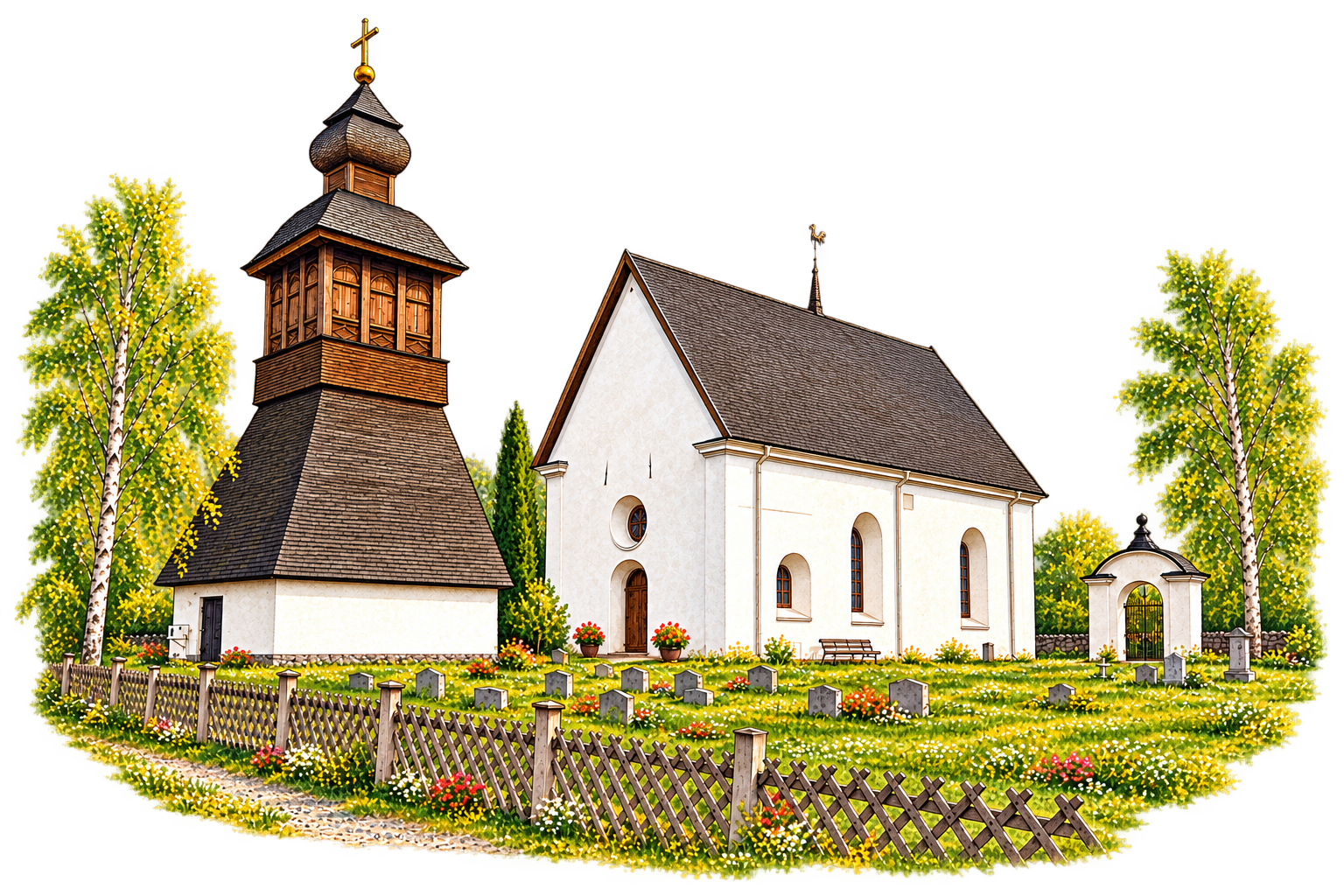
A tall dark roof dominates the white hall, with a tiny weathercock finial along its ridge.
The round western window
An oculus sits directly above the arched doorway, creating a simple vertical pairing on the otherwise plain gable.
The detached timber tower
Its broad flared lower section, timber bell chamber and rounded upper cap contrast with the church’s straight masonry walls.
The full church story
The photograph shows two very different silhouettes. The church is a simple white rectangle beneath a steep shingled roof, with a round window above its western doorway. Beside it, the detached bell tower widens towards its base, stacking dark timber and shingles beneath a small rounded cap. A white arched gateway and low churchyard fence complete the scene.
The parish dates the earliest church to around 1200. In the fifteenth century, the chancel was enlarged, the building extended westwards and two brick star vaults added. Painted decoration followed, drawing on illustrated biblical stories and saints’ legends. The painter is not known.
Some objects are almost as old as the building. A parish account by Ann-Charlotte Agrell reports that the communion chalice and paten have been dated to 1320–1330. Their long survival connects the church’s medieval origins with later generations.
A service book printed in 1553 offers another kind of continuity. Lars Parkman describes its mixture of Latin and Swedish texts, handwritten additions and printed musical staves left for local notation. It records a Reformation in progress, with older and newer practices sharing the same pages.
The church also belongs to the history of the 1675 witch trials. The parish records that the condemned received their last communion here. Kramfors municipality documents the execution of 71 people from Torsåker, Dal and Ytterlännäs at Häxberget, and the part played by both courts and clergy. These were people accused of witchcraft; the story calls for remembrance of the victims, not a celebration of the accusations.
The detached bell tower is much more recent: the municipality’s cultural heritage plan dates it to 1956. Its timber form now stands beside the medieval stone church as another layer in this long history.
Plan a visit
Kyrkvägen 20,, 873 93, Nyland
Opening hours
Opening hours have not been confirmed for the current date. This does not mean the church is closed.
Check access with the parish before travelling. Services and seasonal changes can affect visits.
What’s on at Torsåkers kyrka
Loading calendar… Events will appear here automatically when the first background fetch finishes.
Contact & official information
Torsåkers församling
- Telephone +46 612 85500
- Email kramfors.pastorat@svenskakyrkan.se
Check the official pages below for opening hours and visiting information. We may not have the latest details, and access can change for holidays, services or private ceremonies. If the information is unclear, contact the parish before travelling.
Facilities & accessibility
- Toilet
Listed by the provider; availability has not been independently checked. An unlisted facility is not necessarily unavailable.
Getting there & visiting information
Parish office, Kramfors, Jättestagatan 13
Find your way
Use the interactive map to explore the church and the surrounding landscape.
The interactive map could not load. Use the location link below.