
Gudmundrå kyrka

Gudmundrå kyrka stands above its churchyard with a long green roof and a compact white lantern. Its calm exterior introduces a story of a growing congregation, local craftsmanship and an exceptional sixteenth-century book.
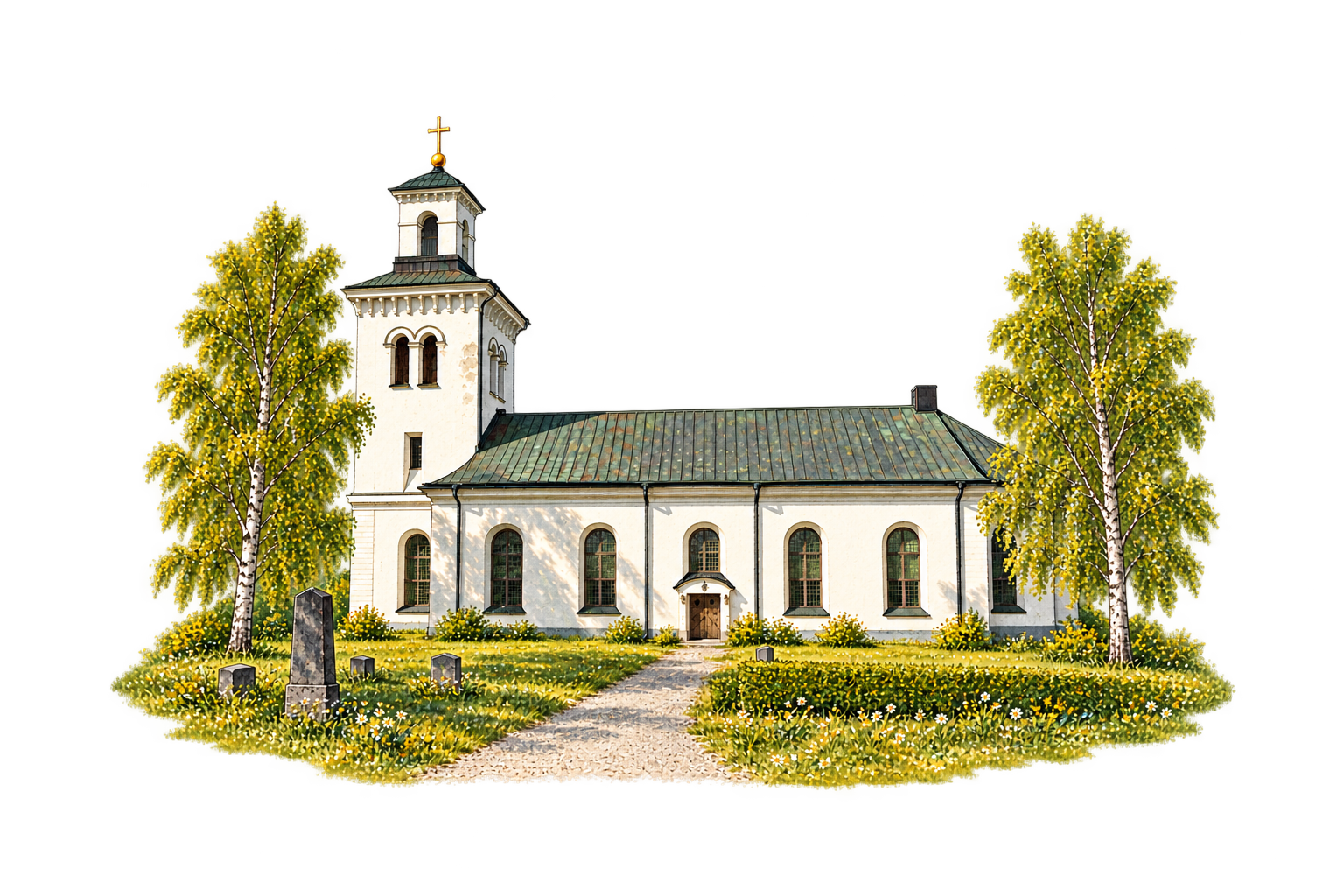
Ink-and-watercolour illustration of Gudmundrå kyrka in Ångermanland, with white walls, a long green metal roof and a western tower with paired bell openings and a short square lantern.
Illustration adapted from a photograph by Hans Lindqvist, Wikimedia Commons · CC BY-SA 4.0. Composition and vegetation adapted; illustration by churchesinsweden.com.
Explore the church’s story

A new church, older treasures

Two centuries of building, furnishing and care.

1799

Work begins

Simon Geting leads construction.

1801

The church opens

Inauguration takes place on 27 September.

1824–1825

New furnishings

Edler and Sundin work on the interior.

1911–1912

Restoration

The church is restored.

1998

A new organ

Menzel’s instrument is inaugurated.

2015

Further restoration

Another chapter of care for the building.

Three things to notice

Look closely at the tower and the rhythm of the wall.

01

The short square lantern

A small open stage rises above the broad tower roof, finished with a low cap, golden ball and cross.

02

Paired bell openings

Two narrow arches sit together high in the tower, beneath a row of projecting cornice brackets.

03

The doorway beneath a window

A curved hood shelters the south entrance. The arched window above it keeps the rhythm of the long wall intact.

The full church story

In the reference photograph, the white church stretches across a gently rising churchyard. A dark green metal roof links the long nave to the western tower. Paired bell openings, a deep bracketed cornice and a short square lantern give the tower its particular character. Below, the central side entrance sits beneath an arched window, reached by a gravel path.

A larger church was needed when the medieval building became too small. Construction began in 1799 under Simon Geting of Högsjö, and the new church was inaugurated on 27 September 1801. It stands on higher ground southeast of its predecessor.

Jonas Edler and Pehr Sundin worked on the furnishings in 1824–1825. A medieval limestone font survives from the older church. The parish also records three tower bells and window glass from Sandö glassworks.

One treasured object is a copy of Gustav Vasa’s Bible, the complete Swedish Bible printed in 1541. According to the parish account, Gudmundrå received it after surrendering a partly gilded monstrance to the Crown in 1548. The volume was restored in the early twentieth century at the initiative of curate John Westin. Its old lettering and spelling preserve a very different reading experience from that of a modern Swedish Bible.

Restorations followed in 1911–1912, 1951, 1984 and 2015. A new organ from Menzel’s workshop in Härnösand was inaugurated in 1998.

Plan a visit

Associated diocese · Diocese of Härnösand

Mariakapellet 101

Opening hours

Opening hours have not been confirmed for the current date. This does not mean the church is closed.

Check access with the parish before travelling. Services and seasonal changes can affect visits.

What’s on at Gudmundrå kyrka

Loading calendar… Events will appear here automatically when the first background fetch finishes.

Contact & official information

Gudmundrå församling

Facilities & accessibility

  • Parking
  • Toilet
  • Hearing loop
  • Accessible toilet

Listed by the provider; availability has not been independently checked. An unlisted facility is not necessarily unavailable.

Toilet: Adapted for disabled access

Accessibility

Automatic door opener
Induction loop: The venue has a hearing loop

Getting there & visiting information

Mariakapellet 101

Find your way

Use the interactive map to explore the church and the surrounding landscape.

Mariakapellet 101Open location ↗
Sources & credits

History checked against Kramfors parish: Gudmundrå kyrka and its account of Gustav Vasa’s Bible, accessed 20 October 2026. The Bible’s acquisition story is attributed to that parish account. Exterior observations and illustration use Hans Lindqvist’s Wikimedia photograph. This is a researched story, not a personal visit account. Existing provider information and credits remain below.

Sources & credits

Provider catalogue data: Svenska kyrkan, Platser, CC BY 4.0. Separately credited descriptions retain their stated source and licence terms. Catalogue and visiting data reformatted from the provider. The English guide combines and abridges separately credited sources below.

Provider record updated: 26 Sep 2024. This is not an independent verification date.

Source record: e4db3003-0666-4410-ab01-20585771a9e4

Guide sources

This English guide combines, abridges and translates the sources below with AI assistance, with editorial contributions by Churches in Sweden. It has not been independently verified. The adapted guide text is licensed under CC BY-SA 4.0. Photographs and map data have their own terms.

Suggest a correction

Church data retrieved 24 Sep 2026. Visiting details have not been independently verified.

Sources, licences & reuse

Independent guide

Churches in Sweden is an independent guide. It is not an official Svenska kyrkan website and does not imply sponsorship or endorsement.

Church information

Source: Svenska kyrkan — Platser, licensed under Creative Commons Attribution 4.0. English adaptations by Churches in Sweden are identified on each profile. Our adaptations solely from Platser are offered under CC BY 4.0. Guides combining Wikipedia with other compatible sources are identified individually and offered under CC BY-SA 4.0; this covers that guide text, not the whole website. Separately credited third-party material retains its stated terms. Independently written descriptions are identified on their profiles. Imported material has not been independently verified. Original names and visiting details are retained; presentation is reformatted. Each profile identifies its source record and any additional supplied credits.

You may reuse the licensed church material under CC BY 4.0, including commercially, with the required attribution, licence link and indication of changes. No additional site restriction overrides those rights. The licence does not automatically cover separately credited images or map data.

Provider disclaimer

Svenska kyrkan supplies Platser data without guaranteeing that it is correct, current, complete across its organisation, or always available. The material is provided as-is and as-available, subject to the licence’s disclaimer of warranties and limitation of liability.

Svenska kyrkan kan ej garantera att den data som finns i Platser:
– är korrekt.
– är aktuell.
– är komplett för hela Svenska kyrkans organisation.
– alltid är tillgänglig.

Preserved provider agreement · Full licence

Automatic diocese associations use the organisation codes from Svenska kyrkan UnitAPI. An association does not establish ownership or denomination. External editorial sources are credited separately.

Map and photographs

Map data: © OpenStreetMap contributors, ODbL and © OpenMapTiles. Tiles and style are served by World Class Maps. Map rendering uses MapLibre GL JS. The map’s own attribution remains visible.

Photographs are credited individually with their own licence or permission. The API data licence does not automatically cover photographs. No images are imported automatically.

Follow the journey

Discover Sweden, one church at a time.

Join Ronald for new church visits, beautiful photographs and the stories behind them. A weekly email when there’s something new to share.


Please confirm your subscription by email. Unsubscribe whenever you like. Privacy policy