Strängnäs domkyrka
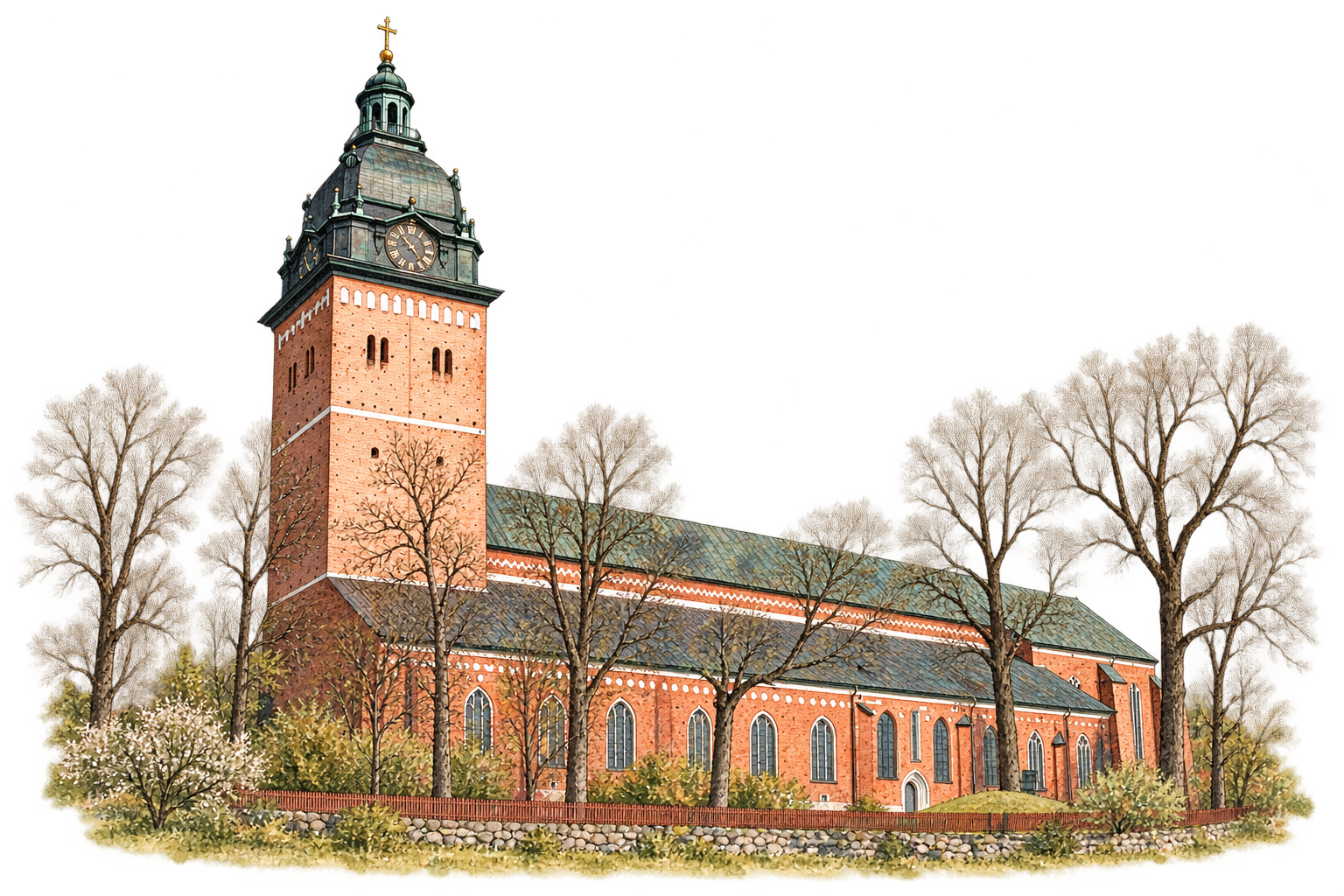
Strängnäs domkyrka stands on a green hill above the streets leading down to Mälaren. Red brick and a broad, dark tower roof give it a distinctive silhouette. Its story joins medieval building, books and royal history, with later restorations woven into the interior.

A cathedral of brick and books
A growing medieval church becomes a setting for national events and learning.
Building begins
The core brick church takes shape.
A traditional consecration date
Parts of the church are said to have been consecrated.
A larger high choir
The eastern interior gains height and space.
The Strängnäs missal is printed
Rogge supports a book for the diocese’s worship.
A king is elected
Gustav Vasa’s election takes place here.
A new tower roof
Rebuilding gives the tower its Baroque cap.
An Art Nouveau layer
Restoration introduces new interior fittings.
Three things to notice
Look a little closer at the building and its changing story.
White details in red brick
Look for the pale decorative bands against the walls and tower.
The high choir
Compare its slender supports and spaciousness with the older central body.
A library within the cathedral
The surviving collection carries a history of worship, scholarship, gifts and war.
The full church story
Construction of the cathedral’s central body began around 1250. Tradition places a partial consecration in 1291, while the core building was finished in the 1330s. Dedicated to Peter and Paul, the church was then enlarged through side chapels, a tower and a more ambitious eastern end.
The high choir, built in 1448–1462, changed the interior’s scale. Slender supports and larger windows distinguished it from the older core. Bishop Kort Rogge’s later building work and his gift of the great high altarpiece added to the cathedral’s medieval richness. In 1523, the church and its churchyard formed the setting for Gustav Vasa’s election as king.
Books were another part of cathedral life. A collection is documented in the 1460s, supporting worship and education. Rogge acquired volumes and initiated the printing of the Strängnäs missal in 1487. The cathedral library preserves the best-surviving copy, a reminder that this was a place of reading and scholarship as well as ceremony.
Fire brought further change. The present Baroque tower roof followed the blaze of 1723. Much later, the 1907–1910 restoration introduced fittings in an Art Nouveau idiom, including pews and choir furnishings. The church’s appearance is therefore a meeting of periods, rather than a single medieval moment.
The library’s seventeenth-century expansion has a more complicated history. Bishop Johannes Matthiae donated his own books, and Queen Christina assigned volumes taken during the Thirty Years’ War. Their origins connect this quiet place to events far beyond Strängnäs. For current opening and guided visits, check the parish website.
Plan a visit
Kyrkbrinken 9, 645 30, Strängnäs
Opening hours
Opening hours have not been confirmed for the current date. This does not mean the church is closed.
Also open at other times during services.
Check access with the parish before travelling. Services and seasonal changes can affect visits.
What’s on at Strängnäs domkyrka
Loading calendar… Events will appear here automatically when the first background fetch finishes.
Contact & official information
Strängnäs domkyrkoförsamling med Aspö
- Telephone +46 152 24500
- Email strangnas.domkyrkoforsamling@svenskakyrkan.se
Check the official pages below for opening hours and visiting information. We may not have the latest details, and access can change for holidays, services or private ceremonies. If the information is unclear, contact the parish before travelling.
Facilities & accessibility
- Toilet
- Hearing loop
- Accessible toilet
Listed by the provider; availability has not been independently checked. An unlisted facility is not necessarily unavailable.
Find your way
Use the interactive map to explore the church and the surrounding landscape.
The interactive map could not load. Use the location link below.