Härnösands domkyrka

Härnösands Cathedral
Address
Franzéngatan 18, 87131, Härnösand
Denomination
Church of Sweden
Associated diocese
Diocese of Härnösand
Last visited by us
10 JUL 2026
Built
Completed in 1846
Style
Neoclassical
Architect
Johan Adolf Hawerman
Age
About 180 years (completed 1846)

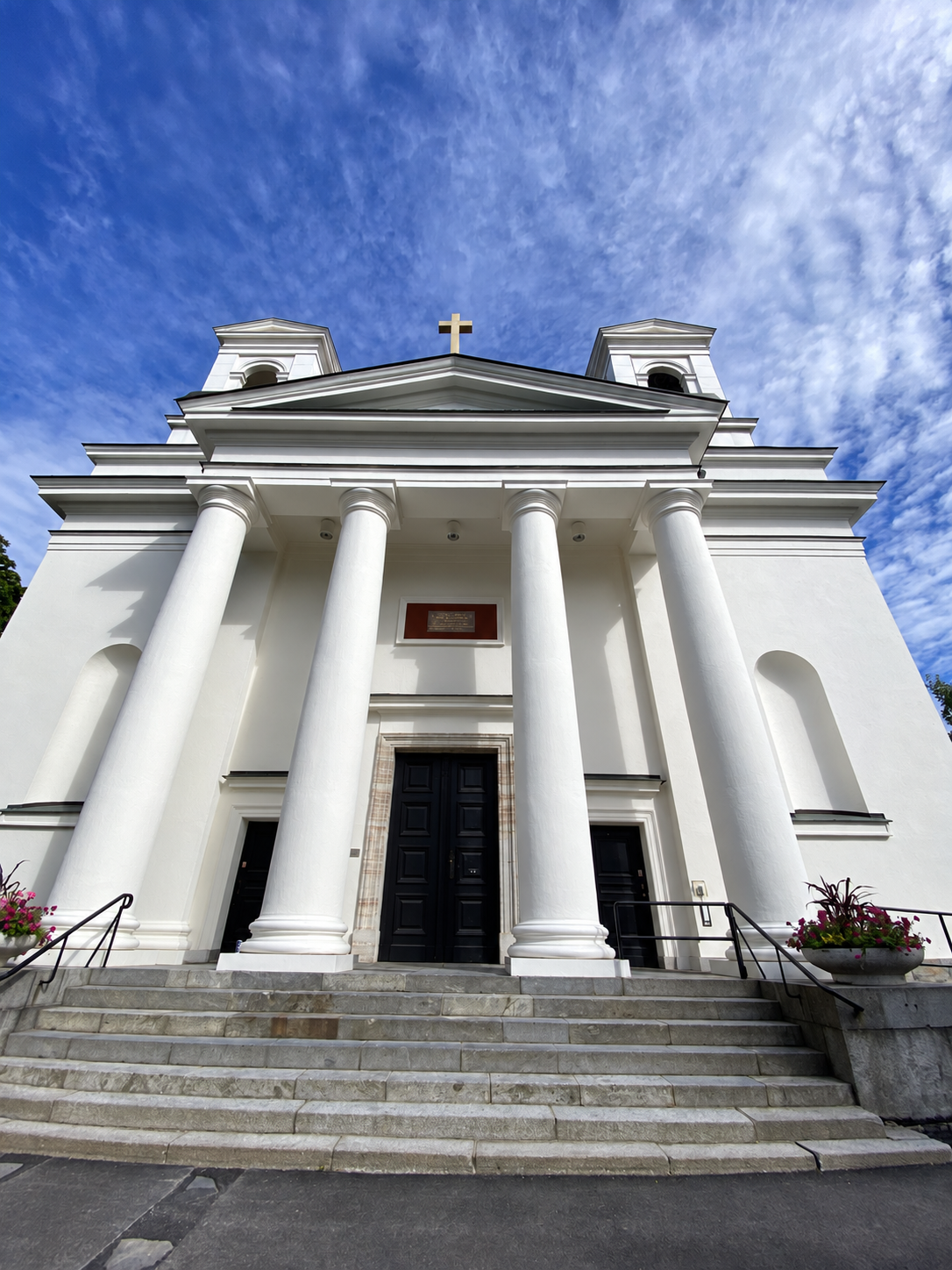
Härnösands domkyrka, the white cathedral of Härnösand, was completed in 1846 to designs by Johan Adolf Hawerman. Standing on a hill overlooking the town, this three-aisled neoclassical building is regarded as one of Sweden's finest examples of the style, both outside and in.


A church has stood on this site since 1593, shortly after Härnösand itself was founded. It became a cathedral in 1647, when the town was made the seat of a new church district covering the newly acquired provinces of Jämtland and Härjedalen. That earlier building burned down during Russian raids in 1721 and was rebuilt the following year, before eventually being replaced by the present structure, erected between 1842 and 1846 by master builder Anders Magnus Atterberg. Part of the original stone church's north wall is thought to survive within the current south wall.

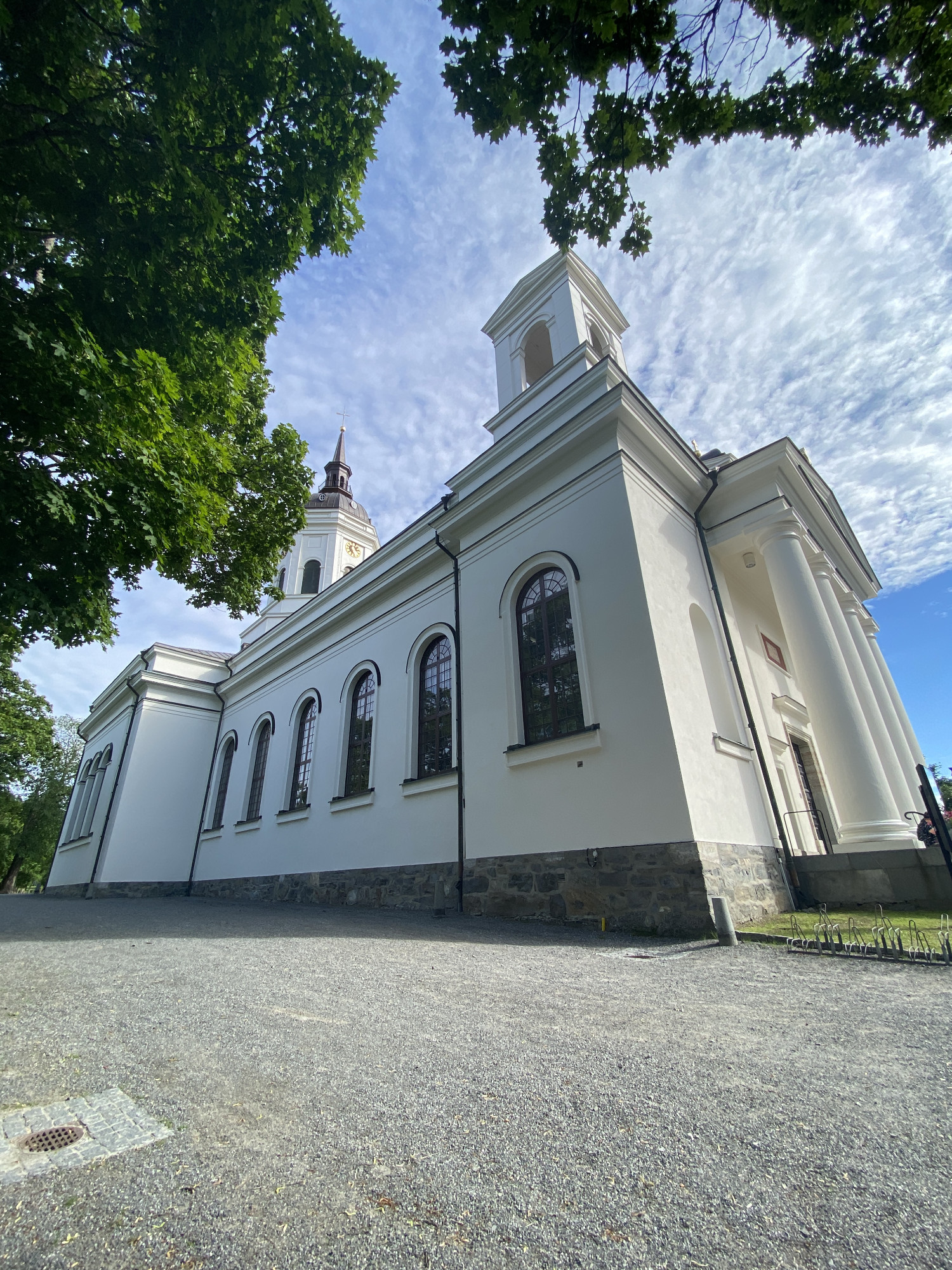
The building is a neoclassical, three-aisled stone church with a transept to the east and a rounded apse. An octagonal bell tower rises above the crossing, and the west front has a Doric portico flanked by two smaller towers. It is sometimes said to be Sweden's smallest cathedral.

Inside, the altarpiece depicting Golgotha is the work of David von Cöln. Four 17th-century chandeliers, rescued from the earlier cathedral, have a dramatic history: in 1720 they were packed into chests and sunk in the nearby sound to keep them from Russian troops, then hurriedly re-hidden in a burial vault the following year when the danger proved to have been premature. A delicate silver baptismal font, a Spanish Rococo piece made in 1777, is reportedly used only at the midnight services of Easter and Christmas because of its fragility; a sturdier stone font serves at other times.

The cathedral's bells and carillon also carry their own story of destruction and renewal: the original bells melted in the 1721 fire, and their metal was recast into new ones in 1723, later recast again. A 36-bell carillon was added in 1981. The present organ was built in 1975 by the Danish firm Bruno Christensen & Sønner and has 57 stops across four manuals and pedal, but its striking case is much older, surviving from the Cahman organ installed in 1731.

A renovation carried out in 2010–2011 included general restoration and redecoration, and saw the chancel reordered with two new chapels.

Opening hours

Provider-listed schedule, applicable on 12 Oct 2026. All times are local to Sweden.

From 3 May 2026; no end date supplied
Monday10:00–15:00
Tuesday10:00–15:00
Wednesday08:00–15:00
Thursday10:00–15:00
Friday10:00–15:00
Saturday10:00–13:00
Sunday10:00–13:00

Check access with the parish before travelling. Services and seasonal changes can affect visits.

Facilities & accessibility

  • Toilet
  • Wi-Fi
  • Hearing loop
  • Ramp
  • Accessible toilet

Listed by the provider; availability has not been independently checked. An unlisted facility is not necessarily unavailable.

A listed ramp does not confirm step-free access throughout the building.

Härnösands domkyrkoförsamling

Härnösands domkyrka

Härnösands domkyrka, the white cathedral of Härnösand, was completed in 1846 to designs by Johan Adolf Hawerman. Standing on a hill overlooking the town, this three-aisled neoclassical building is regarded as one of Sweden's finest examples of the style, both outside and in.

Franzéngatan 18, 87131, Härnösand

Explore this church: Härnösands domkyrka

Church information: Svenska kyrkan, Platser · CC BY 4.0. Each church page includes its credits and visiting notes.

Other churches in the same diocese

Basic listing

Brunflo församling

Brunflo församling is a parish of the Church of Sweden in Östersund municipality, Jämtland, within the Diocese of Härnösand. Its roots go back to the Middle Ages, and its main church, Brunflo kyrka, remains a…

Kyrkvägen 37, 83496, BRUNFLO

View church details: Brunflo församling
Basic listing

Norderö kyrka

Norderö kyrka was built between 1171 and 1172 and is one of Jämtland's best-preserved medieval churches. The stone church, of Romanesque type with a rectangular nave and a narrower, straight-ended chancel, has never been extended.

Fjällgatan 4 C, 83242, FRÖSÖN

View church details: Norderö kyrka
Basic listing

Ådals-Lidens kyrka

Ådals-Lidens kyrka is the parish church of Ådals-Lidens församling, standing at the heart of Näsåker in Sollefteå municipality, Västernorrland. This modest wooden church, built in the early nineteenth century, replaced earlier structures on a nearby…

Pelle Molins väg, Näsåker

View church details: Ådals-Lidens kyrka
Basic listing

Helgums kyrka

Helgums kyrka is the parish church of Helgum, in Sollefteå in northern Sweden. A stone building dating from the late eighteenth century, it stands on a site believed to have held an earlier medieval church,…

Helgumsbyn 172, Helgum

View church details: Helgums kyrka

Sources & credits

Provider catalogue data: Svenska kyrkan, Platser, CC BY 4.0. Separately credited descriptions retain their stated source and licence terms. Catalogue and visiting data reformatted from the provider. The English guide combines and abridges separately credited sources below.

Provider record updated: 12 Jun 2026. This is not an independent verification date.

Source record: 5dab016f-18f3-4973-92d8-69779653a1ef

Building facts: Svenska kyrkan Platser record; not independently verified

Guide sources

This English guide combines, abridges and translates the sources below with AI assistance, with editorial contributions by Churches in Sweden. It has not been independently verified. The adapted guide text is licensed under CC BY-SA 4.0. Photographs and map data have their own terms.

Suggest a correction

Church data retrieved 23 Sep 2026. Visiting details have not been independently verified.

Sources, licences & reuse

Independent guide

Churches in Sweden is an independent guide. It is not an official Svenska kyrkan website and does not imply sponsorship or endorsement.

Church information

Source: Svenska kyrkan — Platser, licensed under Creative Commons Attribution 4.0. English adaptations by Churches in Sweden are identified on each profile. Our adaptations solely from Platser are offered under CC BY 4.0. Guides combining Wikipedia with other compatible sources are identified individually and offered under CC BY-SA 4.0; this covers that guide text, not the whole website. Separately credited third-party material retains its stated terms. Independently written descriptions are identified on their profiles. Imported material has not been independently verified. Original names and visiting details are retained; presentation is reformatted. Each profile identifies its source record and any additional supplied credits.

You may reuse the licensed church material under CC BY 4.0, including commercially, with the required attribution, licence link and indication of changes. No additional site restriction overrides those rights. The licence does not automatically cover separately credited images or map data.

Provider disclaimer

Svenska kyrkan supplies Platser data without guaranteeing that it is correct, current, complete across its organisation, or always available. The material is provided as-is and as-available, subject to the licence’s disclaimer of warranties and limitation of liability.

Svenska kyrkan kan ej garantera att den data som finns i Platser:
– är korrekt.
– är aktuell.
– är komplett för hela Svenska kyrkans organisation.
– alltid är tillgänglig.

Preserved provider agreement · Full licence

Automatic diocese associations use the organisation codes from Svenska kyrkan UnitAPI. An association does not establish ownership or denomination. External editorial sources are credited separately.

Map and photographs

Map data: © OpenStreetMap contributors, ODbL and © OpenMapTiles. Tiles and style are served by World Class Maps. Map rendering uses MapLibre GL JS. The map’s own attribution remains visible.

Photographs are credited individually with their own licence or permission. The API data licence does not automatically cover photographs. No images are imported automatically.